

Five tiles and a thousand years of Persian walls
Girih patterns look impossibly complicated and are built from five shapes. Here is the set, and what the tilemakers were actually drawing.
Draft copy. This piece was written during the site build and is waiting on an editorial pass — the facts are checked, the prose is not final.
Stand in front of a fourteenth-century Timurid wall and the pattern seems to have no beginning. It does. There are five of them.
The five tiles
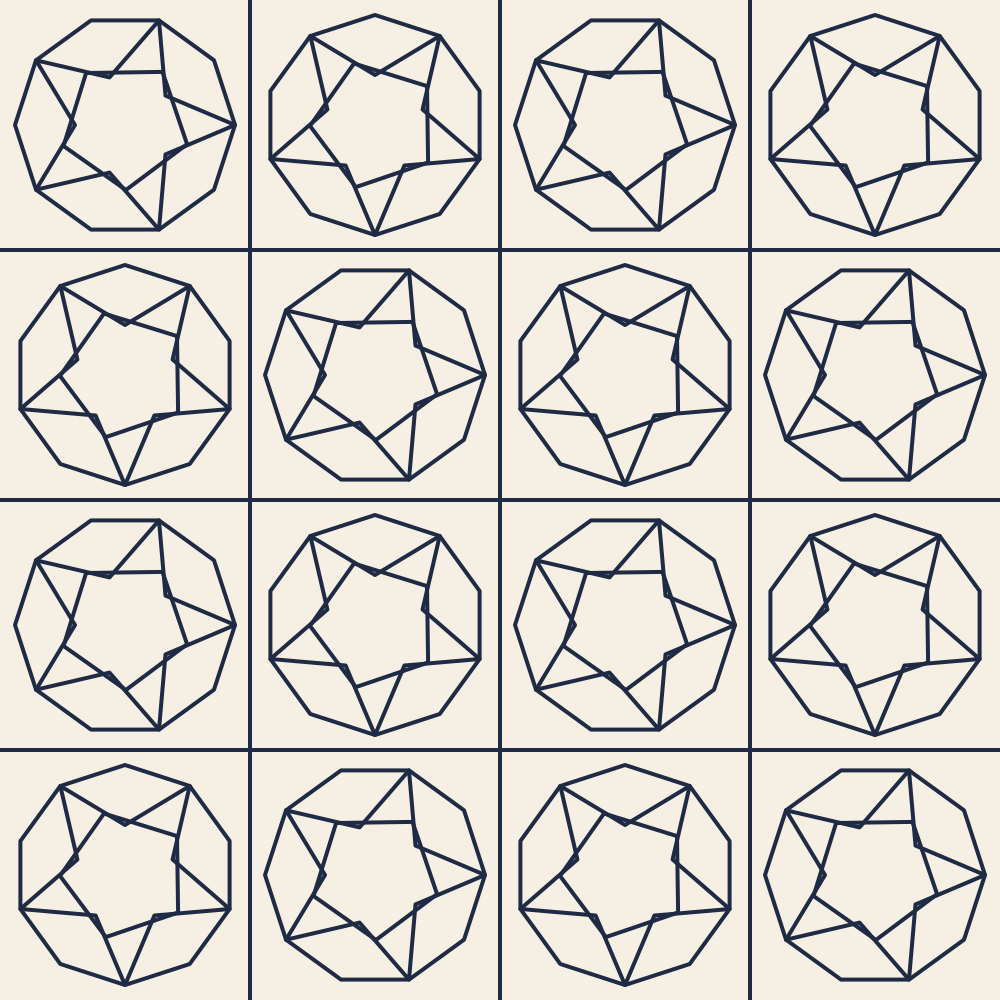
Craftsmen across Persia, Anatolia and Central Asia worked with a small, fixed set of shapes — a regular decagon, a regular pentagon, an elongated hexagon, a bowtie and a rhombus. Every one of them carries the same strapwork lines across its edges, drawn at the same angle, so that when two tiles meet the straps continue across the join without a seam.
The part most people miss
What you see on the finished wall is the strapwork. The tiles themselves are invisible — they are scaffolding, and they get plastered over.
This is why the patterns feel like they could go on forever: they can. The tiling is aperiodic in places, and a famous 2007 paper in Science argued that some fifteenth-century examples anticipate mathematics not formally described in the West until the 1970s. That claim has been debated since, which is worth saying — but the construction method is not in doubt.
Drawing one
You need a compass, a straight edge, and the patience to divide a circle into ten. The rest is repetition. We put thirty of these constructions, in numbered steps, in Draw Geometric Patterns, each one followed by a blank grid so you can do it immediately rather than three chapters later.
Mentioned above
Everything this post points at
Keep reading
Related posts
A labyrinth is not a maze
One has a single path and no choices. The other has junctions and dead ends. Calling them the same thing mis-sells the page.
"Bold and easy" is a design brief, not a lower standard
Thick lines and open fields are harder to draw well than intricate ones. Here is the test we use.
What a kolam actually is, and why the dots come first
A kolam is one unbroken line looped around a grid of dots. That constraint is the whole art form — here is how it works and how to draw your first one.